Buy domain names
Secure the domain that builds your brand










Get full power without the price hike
We include the essentials (like SSL) so you don't hit a paywall later. No surprises.
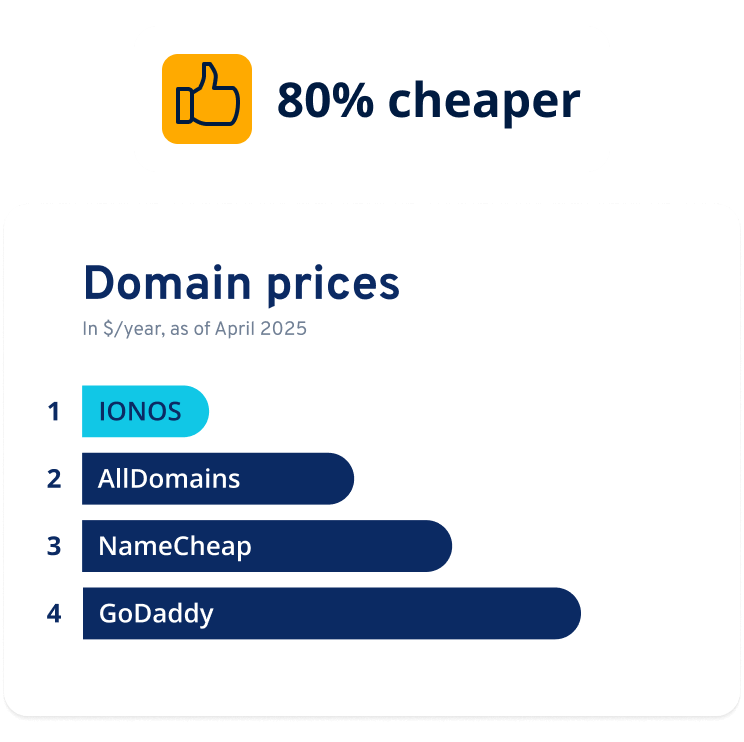
Why register with IONOS?
Partner with a proven expert
Stuck on a name? Let AI help
Transfer to us with ease
Move your domains to us to manage everything in one place. You get intuitive tools and a personal consultant to support you.
Find the perfect match for your niche
Protect your visitors and your asset
Turn your domain into a business
Everything you need to grow after your domain
Domain
Launch your project
Secure the name that makes it real.
Email
Spend less time in your inbox
Let AI handle the heavy lifting. Automatically draft replies, summarize long threads, and translate on the fly.
Website
Build your home on the web
Go live today with professional, easy-to-use design tools that make your brand look alive.
Marketing tools
Get found by the right customers
Stop shouting into the void. Use powerful tools to boost your search rankings and grow your audience.
Online store
Start selling while you sleep
Launch a global storefront that works 24/7. Turn visitors into customers from anywhere in the world.
Business tools
Streamline your daily workflow
Get your team on the same page. Boost productivity with integrated tools designed to keep your business moving.
VPS
The power to scale your own way
Get the maximum security and flexible performance you need for high-traffic projects. Total control, no limits.
Cloud
Scale fearlessly on your terms
Grow your infrastructure instantly with high-performance cloud services built on the strictest security standards.
Leading brands and partners rely on IONOS







Only at IONOS
Your personal consultant
Not only do you get the latest AI tech, but you also get your own personal consultant to guide you every step of the way.
24/7 expert support
Technical questions? Our award-winning experts are always available to help by phone, chat or email.
Domain names — FAQs
A domain extension is also known as a top-level domain (TLD). It's the last part of a domain name — in the domain name ionos.com, .com is the domain extension.
There are different kinds of domain extensions
ccTLDs are top-level domains that represent a nation — the 'cc' stands for country code. Some of these domain extensions can require a presence in the relevant country. A .uk or .us domain are examples of ccTLDs. Some of the country code extensions are classified as generic ccTLDs by Google — gccTLDs. This is because the domain is not always used to represent a country. For instance .cc and .io are generic country code top-level domains. The .cc extension is officially the country code extension for the Cocos (Keeling) Islands near Australia, but is also used as 'commercial company', while .IO is the ccTLD for the British Indian Ocean Territory, but is also used to represent 'input/output'.
gTLD is short for generic top-level domain. The classic domains .com, .org, and .net are generic domain extensions.
nTLDs are new top-level domains. They include extensions such as .london, .tech, and .cloud.
Certain domain extensions have eligibility requirements, the extension .gov is restricted to use by government entities. IONOS does not offer these domain extensions.
Learn more about domain extensions
The cost of a domain name depends on the domain extension and the registrar you choose. Standard domain extensions such as .com, .net, or .org typically cost around $10–$20 per year for domain registration. Other extensions, including newer or specialty Top-Level Domains, may have different pricing.
Some domain names may also be classified as premium domains. These are usually short, memorable, or high-demand names and can cost significantly more than standard registrations.
With IONOS, new customers can often register their first domain name for $1 or less for the first year, depending on the domain extension. This makes it easy to get started with your online presence at a low cost.
Domain names are typically registered on a yearly basis. To keep ownership of your domain name, you need to renew your domain registration before it expires.
Learn more
It’s easy to register a domain name. Here’s our step-by-step guide.
- Choose the domain name you want for your website. You can register more than one.
- Check whether your domain name is available using our domain checker tool. This will tell you if the domain contains invalid characters or if it’s already claimed.
- If your preferred domain name is taken, you’ll be given alternatives.
- Add your chosen domain(s) to your cart. There may be several different package options to choose from depending on your needs.
- Check your order for details such as the domain’s expiration date and how many domains you’re registering.
- Create your customer account if you don’t already have one.
- Select your payment method and purchase your domain(s).
If you’re already an IONOS customer, you can add new domains by logging in to your account and clicking Add new domain in the domains drop-down menu.
Subdomains are useful for organizing your website into different categories. Possible categories include:
Geographical areas or language groups
For example, if your website is in English and Spanish, a subdomain may be used to indicate that this section of your website will be in Spanish, and not English — so instead of just ionos.com, es.ionos.com would be used.
Product-oriented sections
If your website offers a variety of different services or products, you can create a subdomain for each one, for example blog.ionos.com.
Gated content
Having a separate subdomain for logins or account pages on your website is a useful way of organising your site.
By using a subdomain, you'll be able to track the success of your website more accurately, as you'll see how different sections are performing.
Learn more
It's easy for you to move your domains to IONOS, and you can start enjoying the benefits of our affordable hosting services right away. It's clear that you won't want to lose your unique domain name, or the hard work you've already put into your website — that's why we make every domain name registration or transfer hassle free. Start by selecting a hosting package from our website that best matches your needs, then enter your existing domain name into the domain checker. At this point, you'll be informed that your domain already exists; simply select 'transfer' and then enter the authentication code you'll receive from your former provider.
Make sure you have created backups of all your site's files, plus any databases or email accounts with your former domain provider before you initiate the transfer. This data will not transfer automatically with the domain. You should also copy your previous DNS settings and subdomains with that domain. There's no rush- as an existing IONOS customer you can easily transfer your domain from another provider at any time.
Every domain name is linked to a numerical internet address known as an IP address. An IP address is a long string of numbers that computers use to identify each other online. Domain names make it easier for people to visit websites because you don’t have to remember these numbers.
When you visit ionos.com, your browser checks our site’s DNS records to find the files for our website, which are stored on a server. This process happens almost instantly and directs your browser to the correct location so the website can load.
Like IONOS, most hosting providers automatically create DNS records when you complete a domain registration.
Sometimes you may want to keep your domain name registered with one provider while hosting your website files or email accounts with another company. In that case, you can update your DNS records so the domain points to a different server.
This process is known as a DNS transfer and typically takes a few days to complete. For example, if your domain registration is with a provider that charges high hosting fees, you can keep your domain name there and move your hosting to a more affordable provider like IONOS.
Learn more
A domain registry is the organization responsible for managing a specific domain extension, also known as a Top-Level Domain (TLD), such as .com, .org, or .net. The registry maintains the central database of all registered domain names within that extension.
When you complete a domain registration through a registrar like IONOS, the registrar submits your domain name to the appropriate registry. The registry then records the domain registration and ensures that the domain name is unique and assigned to the correct domain owner.
Registries do not sell domains directly to most customers. Instead, they work with accredited registrars such as IONOS, which handle the registration process, billing, and customer support.
In simple terms, the registry manages the domain extension itself, while registrars like IONOS allow you to search for, register, and manage your domain name.
Learn more
No, domain names are only registered for a specific period of time. Typically, a domain name is registered in your name for one year. After this "billing period," you must renew the registration. In fact, you are essentially renting the "domain name," and this contract usually requires annual renewal.
Thanks to the "automatic renewal" of your domain, you don't need to worry about this as an IONOS customer. Your contract is renewed every year automatically unless you decide otherwise. This ensures that no one can snatch your "domain name" away—even though a "domain registration" is not a one-time purchase.
Learn more
 Domain name generator
 Free Domain Name
 Domain hosting
 AI email writer
 Free VPS
 .ae domain
 .biz domain
 .gg domain
 .site domain
 .store domain
 .xyz domain
 Create a business website
 Free Website Hosting
 Free online store
 Create your own website